
The World Once Spoke Tens of Thousands of Languages
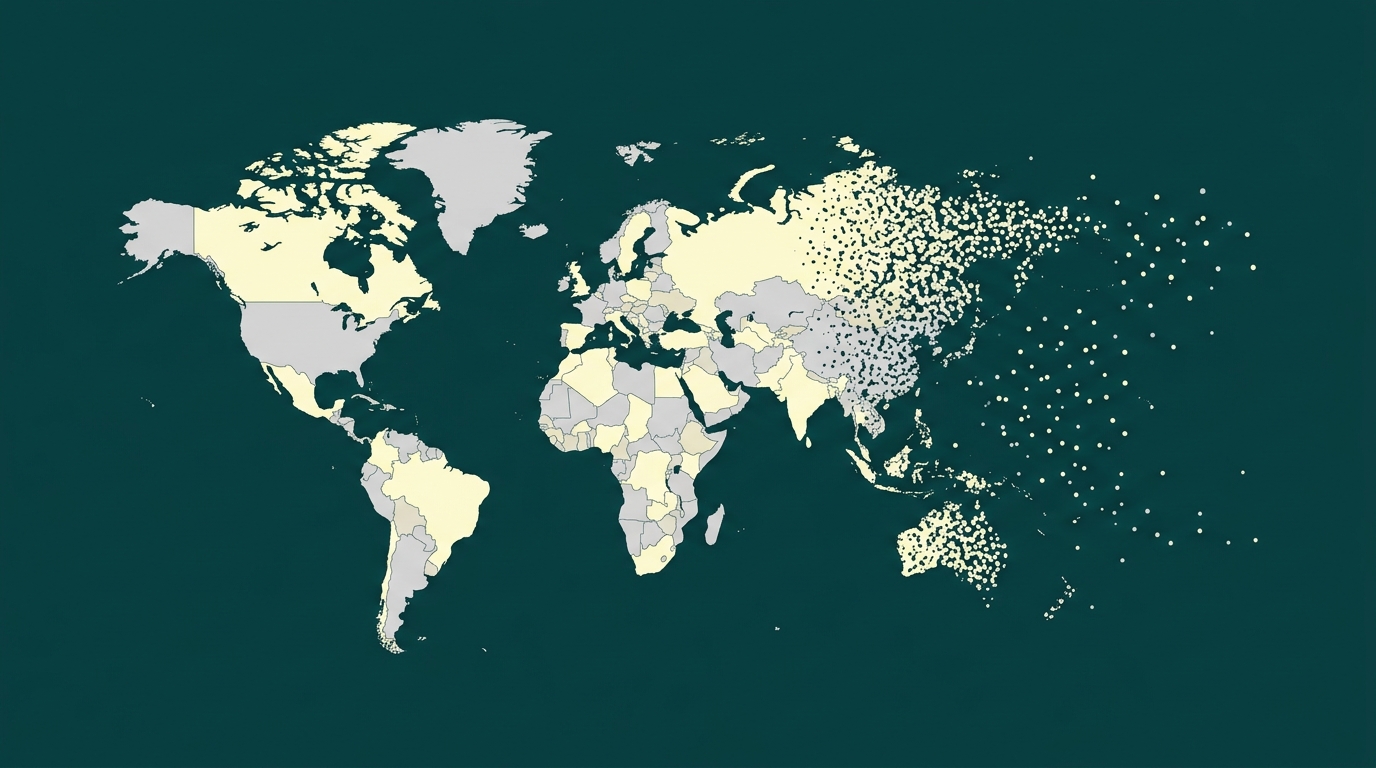
Roughly 7,000 languages are spoken today, and the number is falling. A study published in Science in July argues that this decline is far older than usually assumed.
Damian Blasi (ICREA and Harvard), Marcus Hamilton (Texas at San Antonio), Russell Gray (Max Planck Institute for Evolutionary Anthropology) and Claire Bowern (Yale) reconstructed global linguistic diversity across the Holocene by modelling how the number of distinct languages tracks population. Their trajectories show diversity rising for most of the last 12,000 years — from an estimated 4,500 to 6,200 languages at the start — peaking between 1,000 and 3,000 years ago at roughly ten times that figure, and then collapsing.
The familiar account places the beginning of language loss at European colonial expansion, some five centuries ago. This work puts it considerably earlier, with the multinational states and empires that came before.
The authors are explicit about the limits. This is a coarse global reconstruction rather than a count. It rests on assumptions about the size of early ethnolinguistic groups, and it cannot say which particular empires or events drove the decline.